
Mining Test - TKPH
The TKPH plugin for VBOX Test Suite gives you the ability to generate reports to summarise the performance across different circuits and check if the vehicle TKPH is exceeding the tyre TKPH.
The plugin includes features such as algorithms for cycle TKPH, average TKPH, Michelin/Bridgestone TKPH corrections and inputs for Load/Dump locations, ambient temperature, vehicle weight data and tyre specification data.
Ribbon - Test Setup
The TKPH plugin as a unique Test Setup ribbon, from which you can configure the test and test area.

Test Section

Configure
Report
Maths Channel
Save Settings
Click on the Save Settings button to save the current test setup and add it to the Saved Settings area in the Add Test window.
The test will also be added to the list under the Mining button on the Home tab for easy access.
Export
Gate Section

Add Gate
 |
Click on the Add Gate button to add a virtual gate to the chart and map at the point of the cursor. Gates are indicated by green lines. The currently selected gate will be indicated by a blue line. You can now use the gates to define start and/or end conditions. |
|
Note: Opening a plugin (either as a new tab or overwriting an existing one) will clear all set gates, requiring you to redefine the gates before you amend the test configuration to set start/end conditions. |
Gate Name
Width
Rename
Delete
Delete All
Export
Import
Data Column Section
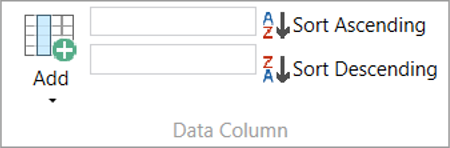
Add
Channel
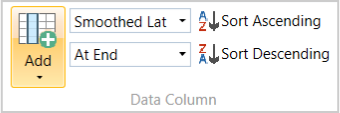
When you select a column header in the Test Results area, the channel name will be displayed in the Channel box (the top box in the Data Column section). Some columns will have required channels and cannot be changed, but if you can change the channel, the Channel box will become a drop-down list with the available channels.
|
|
|

Result Condition
Sort Ascending
Sort Descending
Run Section

Select All
Deselect All
Session Section
Edit Data

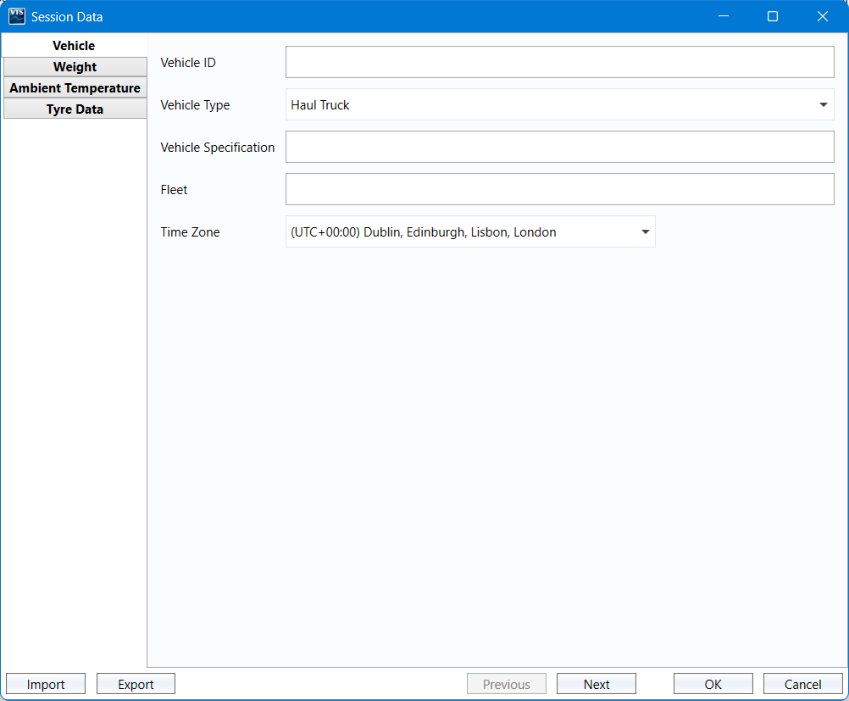
Click on the Edit Data button to open the Session Data window and add various vehicle and test information, such as:
|
Vehicle
|
Weight
|
Ambient Temperature
|
Tyre Data
|
Help Section
Help

Click on Help to automatically open an Internet browser and load the relevant section of the User Guide on the Racelogic Support Centre.
| Note: This page will only be displayed if there is a valid internet connection. If there is no valid internet connection, a cached version of the relevant section (from the last software update) will be presented in PDF form. |
WorkSpace
Chart


Y-Axis
In 'Chart', you will see several mining-specific parameters when you click on Y-Axis. Note that the X-axis is displayed as elapsed time, whereas calculations are based on UTC time so the exact shape may not be reflected in the Report, which produces results against an X-axis of local time.
Cycle TKPH represents the TKPH value calculated for that cycle, from the load point to the following dump point to the following load point. Front and Rear Cycle TKPH values can be represented in the Chart area.
Moving avg. represents the rolling average of TKPH based on the interval set in Test Configuration (default set to 4-hour moving average). If no load/dump locations are defined, it will be assumed that half of the time is spent loaded and half of the time is spent unloaded. Front and Rear moving avg. values can be represented in the Chart area.
Map


Add Region
On the Map, you can define load/dump locations by selecting Add Region. This allows the software to detect whether a vehicle is loaded or unloaded based on regular movements.
Ensure that the region is placed correctly so as not to miss any areas in which load status may have changed. For instance, make sure all dump locations are captured as dump regions and all load points are captured as load regions. To reduce the chance of error, avoid load/dump regions at traffic hold points, such as intersections.
You can also rename load/dump locations as the relevant circuit will be represented in Results and the Report as “Load”-“Dump”-“Load”.
Test Settings
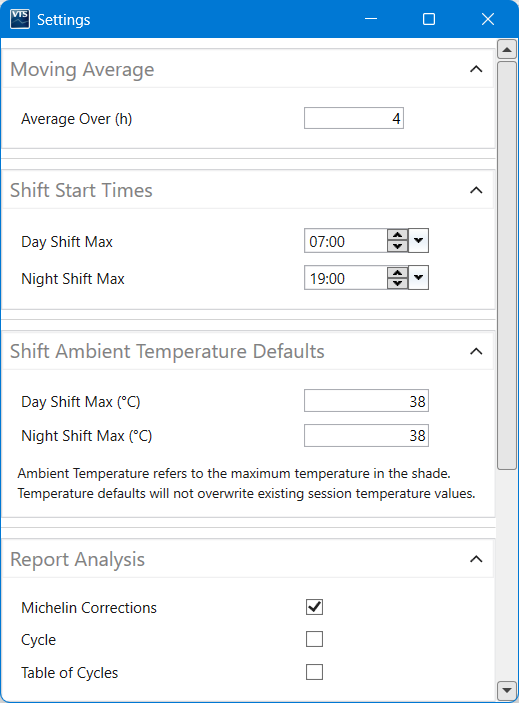
If you are creating a new test, the Settings window will open when you add the new test. This is where you can define the test parameters.
If you have already added an Accel test and you have it open, you can click on the Configure button to open the Settings window to define or amend the test parameters.
Moving Average
Average Over (h)This setting configures the time period, n hours, as a subset of the full VBOX data set over which the TKPH Moving Average is calculated.
This setting will also affect the calculation of the Avg and Avg (Mich) trendlines on the Front TKPH by Local Date and Time chart, which is displayed on the Report.
|
 |
Shift Start Times
Day Shift Start / Night Shift StartThis setting configures the two shifts, to which the user can assign two ambient temperature values.
|
 |
Shift Ambient Temperature Defaults
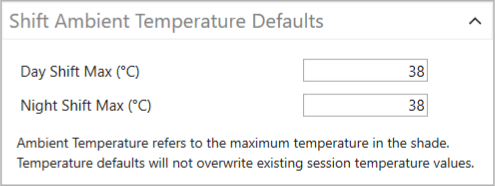
Day Shift Max / Night Shift MaxThis setting configures the default value of the Ambient Temperature to apply to the two daily time periods labelled as Day Shift and Night Shift. This setting will affect the calculations of Bridgestone and Michelin corrections, which refer to ambient temperature. These results can be seen on the Front TKPH by Local Date and Time chart, which is displayed on the Report. Ambient Temperature refers to the maximum temperature in the shade. If there is existing temperature information stored on the VBOX file as Session Data, then these values will not be used. The default value for Day Shift Max and Night Shift Max is 38 °C. This will result in no ambient temperature corrections being made as the TKPH ratings for tyres are rated at 38 °C. An overall maximum temperature in the shade can be applied by setting this temperature value to both fields. Alternatively, two levels of resolution for Ambient Temperature can be achieved with both field entries. |
 |
Report Analysis
Michelin CorrectionsThis setting configures if Michelin Corrections, as per the tyre manufacturer's earthmover data book, are displayed on the Report. This setting only affects the Front TKPH by Local Date and Time chart, which will include lines to represent a Moving Average with Michelin Corrections applied and Cycle TKPH with Michelin Corrections applied if Cycle is ticked. This allows users to display or hide lines on the Front TKPH by Local Date and Time chart, which can be useful to adjust the Report to easily focus on particular areas.
CycleThis setting configures if Cycle TKPH is displayed on the Report. This setting only affects the Front TKPH by Local Date and Time chart, which will include lines to represent Cycle TKPH if checked. This allows users to display or hide lines on the Front TKPH by Local Date and Time chart, which can be useful to focus on particular areas of the Report. Table of CyclesThis setting only affects the last page of the report, which will generate a Table of Cycles if checked. This allows users to check Michelin Corrections on a cycle-by-cycle basis. |
 |
Advanced
|
This setting configures the duration of time over which the vehicle must be considered stationary in a load area for a load event to take place. This affects each valid run (i.e. cycle) to signal a change in load status. Therefore, this affects all calculations of operating site TKPH, as well as the Vehicle Weight Channel introduced in the Chart. It is expected that a load event will take a longer time to take place than a dump event, therefore an appropriate default value has been assigned for this duration. Once GPS speed drops under 0.8 km/h in the load area, the vehicle is considered stationary and when the Minimum load time elapses whilst the vehicle remains stationary (or below Maximum load speed), this will constitute a load event. Although a sufficiently high value may ensure the real load event is captured (and not a brief stop before departing the load area for example), the higher the value the more susceptible it would be to incorrectly detect cycles. If cycles are not being detected as expected, this value can be reduced to ensure the stationary period will be considered as a change in load status. However, with a low value, actual loading time may not be captured accurately. Minimum dump time (s)This setting configures the duration of time over which the vehicle must be considered stationary in a dump area for a dump event to take place. This affects each valid run (i.e. cycle) to signal a change in load status. Therefore, this affects all calculations of operating site TKPH, as well as the Vehicle Weight Channel introduced in the Chart. It is expected that a dump event will take less time to take place than a load event, therefore a default value of 0.5 seconds has been assigned for this duration. Once GPS speed drops under 0.8 km/h in the dump area, the vehicle is considered stationary and when the Minimum dump time elapses whilst the vehicle remains stationary (or below Maximum dump speed), this will constitute a dump event. Maximum load speed (km/h)This setting configures a limit so, in a load area, any speed value below this limit is still considered as the vehicle remaining stationary. This affects each valid run (i.e. cycle) to signal a change in load status. Therefore, this affects all calculations of operating site TKPH, as well as the Vehicle Weight Channel introduced in the Chart. This allows users to mitigate noisy data which may cause erratic speed values when the vehicle is actually stationary. This setting only applies after the vehicle initially becomes stationary (i.e. speed < 0.8 km/h), and will not work if the vehicle does not come to a complete stop in the load area. Maximum dump speed (km/h)This setting configures a limit so, in a dump area, any speed value below this limit is still considered as the vehicle remaining stationary. This affects each valid run (i.e. cycle) to signal a change in load status. Therefore, this affects all calculations of operating site TKPH, as well as the Vehicle Weight Channel introduced in the Chart. This allows users to mitigate noisy data which may cause erratic speed values when the vehicle is actually stationary. This setting only applies after the vehicle initially becomes stationary (i.e. speed < 0.8 km/h), and will not work if the vehicle does not come to a complete stop in the dump area. Moving average interval (s)This setting configures the duration, in seconds, of the interval where TKPH is calculated for each interval to build a Moving Average value out of regular sized intervals. This setting affects the Moving Average calculation, and therefore has an impact on any instance of the TKPH Moving Average. “n second TKPH” values are used to build the TKPH Moving Average. A “n second TKPH” value is calculated like Cycle TKPH, but the length of the cycle is n seconds and the load status is checked at the start of the n second interval. When load and dump areas are not defined, the moving average will assume a 50%/50% split of time spent loaded and time spent unloaded for the moving average TKPH calculation. Log Calculations to CSVThis setting configures if cycle calculations, which include Bridgestone and Michelin corrections, are generated as a Comma Separated Value (.csv) file for the user. If checked, this will generate files to be located in C:\ProgramData\Racelogic\VBOXTestSuite\Mining. If checked, this will take longer to generate results, so this functionality is recommended only for investigating particular results and not for general use. |
 |
Test Results Area
Rename File
Edit Session Data
Result Columns

The Test Results area has the following default columns:
| Run | Indicates which run number the results relate to, with run one being the first run completed. There is also a selection box that, when ticked, includes the run in the graph and into the Average/Max/Min/Standard Deviation calculations. Once selected, a coloured square will appear to indicate which colour this run is displayed as on the graph.
|
|
| Circuit | The route taken by the vehicle from a load site to a dump site and then back to a load site. | |
| Start | The Local time the run started. | |
| Dump | The local time the vehicle arrived at the dump site. | |
| End | The local time the vehicle arrived back at a load site. | |
| Time | The total duration of the circuit. | |
| Loaded | The duration spent in a loaded state (i.e. from the load to the dump site). | |
| Empty | The duration spent in an unloaded state (i.e. from the dump site to the load site). | |
| Dist (m) | The distance travelled during the circuit. | |
| Loaded (m) | The distance travelled with the vehicle in a loaded state (i.e. from the load site to the dump site). | |
| Empty (m) | The distance travelled with the vehicle in an empty state (i.e. from the dump site to the load site). | |
| Avg Speed (km/h) | The average speed of the vehicle across the whole of the circuit. | |
| Loaded (km/h) | The average speed of the vehicle while in the loaded state (i.e. from the load site to the dump site). | |
| Empty (km/h) | The average speed of the vehicle while in the empty state (i.e. from the dump site to the load site). | |
| Cycle TKPH Front | The TKPH figure calculated for the front tyres during the cycle. | |
| Cycle TKPH Rear | The TKPH figure calculated for the rear tyres during the cycle. | |
| Temp (°C) |
The ambient temperature during the circuit. This figure will be either the Day or Night shift ambient temperature depending on the time of day and the configured shift start times. |
The software will automatically add columns based on the configured settings.