
Getting Started
Registration
Please register your LabSat 4 so that Racelogic can continue to provide you with notifications about the latest software releases and firmware upgrades for your Racelogic product, and offer technical support.
What is in the box?
LabSat 4 Replay Only variants are supplied with:
| Product Code | Quantity | Description |
|---|---|---|
| LS04-V1 | 1 | LabSat 4 Unit |
| RLVBACS020-X | 1 | Mains power Supply - Lemo 2W cable (country-specific) |
| RLACS313 | 1 | 8 GB SD Ultima Pro UHS-1 Memory Card |
| RLCAB071-1 | 1 | SMA connector - non-hex SMA plug to non-hex SMA plug RG174 (1-metre cable) |
| RLCAB082-1 | 1 | SMA Plug - MCX plug RG174 (1-metre cable) |
| RLCAB083-1 | 1 | SMA plug - MMCX plug RG174 (1-metre cable) |
| RLCAB084-1 | 1 | SMA plug - TNC plug RG174 (1-metre cable) |
| RLACS202* | 1 | LabSat 3/4 - Expansion Connector Adapter (including screwdriver) |
| RLACS289 | 1 | USB 3.0 to SATA adapter cable |
| RLCAB042 | 1 | USB 'A' to USB 'B' - 2m cable |
| RLACS197 | 1 | LabSat 3/4 Carry Case |
| PARAGON-LIC | 1 | Paragon Software Free Licence Code Flyer |
| LS-WARR NOTE | 1 | Warranty Note |
| RLCALUKAS | 1 | Certificate of Calibration |
| BATTERY DEC | 1 | Battery Declaration for international shipping |
| *RLACS202 is not supplied with LabSat 4 Lite variants. |
Optional Extras
| Product Code | Description |
|---|---|
| RLACS225 | GNSS Test Enclosure |
| RLACS278 | Passive Rebroadcast Antenna |
| RLACS261 | Locking Expansion Connector |
| RLACS361 | LabSat4 Dual Sync Cable |
Power Supply
Battery
LabSat 4 is shipped with a rechargeable, lithium-ion smart battery pack. A fully charged battery provides a unit operation time of a minimum of 1 hour. You can charge the battery by connecting an external power source to the Power port on LabSat 4.
|
Notes:
|
|
WARNING
|
You can read more about the battery pack, including operation, charging, fitting, removal and handling, here.
External Power
You can apply power to LabSat 4 via mains power with the RLVBACS020 power supply. When you power LabSat 4 from an external source, it will automatically charge the internal battery pack and seamlessly switch to battery operation when the external power is removed.
Media
LabSat 4 uses different media types for different operations.
Solid State Drive (SSD)
LabSat 4 replays scenario files from the internal SSD.
You can read more about the compatible media for LabSat 4 here.
USB Storage Device
LabSat 4 has a Host USB port that you can use to connect a USB storage device.
This USB device can be used to replay scenario files and to transfer files to and from the internal SSD.
Network Share
You can also connect to and use Network File Systems (NFS), such as Windows File Explorer to access and manage your files and high-speed Network Attached Storage (NAS) devices to replay from.
SD Card
The 8 GB SD card that is included with LabSat 4 can be used for firmware upgrades and to transfer files to and from the internal SSD. You cannot use it to record/replay scenario files.
| Note: To reduce the risk of any unwanted signal noise, you should remove the SD card from LabSat 4 when you are not performing a firmware update or transferring files. |
Web Server
LabSat 4 has a complex array of settings for both GNSS signal and external data replaying. To simplify the configuration and device control process, LabSat 4 has an internal web server that you can easily access via Ethernet and a standard internet web browser.
You can read more about the LabSat 4 Web Server, how to connect to it and how to use it here.
GNSS Monitor
|
|
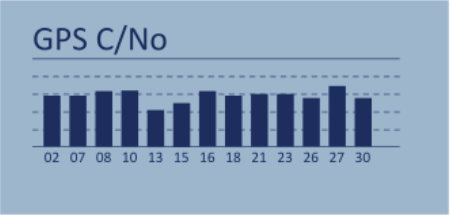
LabSat 4 features a multi-constellation GNSS receiver that you can use to monitor L1 band GNSS signals in the outgoing RF signal during a replay. The USB device connector on the rear panel of LabSat 4 functions as a virtual serial connection and will output NMEA data from the GNSS monitor at 115,200 baud when it is recording or replaying. In addition to this, you can press the OK button when the unit is replaying to switch the display to show satellite tracking levels for GPS L1, GLONASS L1, Beidou B1 and Galileo E1 satellites. Press the Up and Down arrows while in this display to swap between constellations. During replay, the GNSS monitor will listen to the RF output signal. If the replayed signal contains valid L1 GNSS signals, these will be reported by the monitor. |
.png?revision=1)
|
Note:
|
Notice: System Heat Management for LabSat 4Labsat 4 is equipped with a high-performance processor that generates heat during operation. To manage this heat, an internal fan is used to extract warm air from the enclosure. Additionally, the aluminium casing will radiate some heat, causing the system to become warm during use. To ensure optimal performance and prevent overheating, please follow these guidelines:
Following these precautions will help maintain a healthy system temperature of Labsat 4. |